Tuesday, December 29, 2009

The Business of Ethnography

Ethnography has suddenly become a buzzword in the business world. But there is not much clarity on how to use this tool effectively in business. Many businesses confuse ethnography with anthropology and think that it is not suitable for the fast paced business world.

Over a half-century ago, an anthropologist conducting ethnography for a clothing manufacturer observed children and mothers at home and at play. His gaze fixed on overalls, the anthropologist recommended that the manufacturer double-stitch the seams of that garment, previously single stitched, in order that it withstand frequent launderings, and he also suggested the company replace buttons on the straps with metal grippers in order to extend the life of the overalls as the child wearing it grew. This case study appears in a 1961 article titled "Anthropology's Contributions to Marketing" that also lists several other ethnographic encounters with the business of research, from the design of products like chairs and knobs to the development of cosmetics ads that incorporated the culture's symbolic understanding of a woman's eye and mouth.

This article shows that ethnography had been in existence for some time and that it can be effectively applied to businesses. We also realize that it is often rapid ethnography that provides insights that can be turned into profitable business ideas.

Rapid Ethnography

This is an observational technique for going to the prospective users of a product or service and observing the activities they perform, their interactions, and the subculture in which they live, work, learn, and play. Rapid ethnography is critical to the invention of new product classes.

Rapid ethnography shares many of the characteristics of ethnography, but differs in two main ways:

1) More than one researcher is always involved in data collection and the teamwork is essential for data triangulation;

2) More than one researcher is involved in an iterative approach to data analysis and additional data collection.

Ethnography in Business

Case of Revolution Showerheads

In 1996 Moen Inc. was determined to figure out what people really wanted in a showerhead. It engaged QualiData Research to conduct an ethnographic study.

This case provided a challenge, since it would be difficult to actually observe anyone using a shower. QualiData Inc decided to meet this challenge by installing a small moisture-proof camera next to the showerhead of volunteers.

So in 1996 and again in 2001, QualiData taped several dozen people of all shapes and sizes while a camera crew monitored the event from just outside the bathroom.

On tape, the subjects used the water to relax or energize themselves. They lost track of time. One man prayed. The team realized that for many people having a shower was more than a cleaning experience. Based on Moen's research, its "Revolution" showerhead was born.

Priced at the upper end of showerheads, the "Revolution" offers users a dial that can can be easily adjusted with one hand. The showerhead spins the droplets, which hit all points of the body with more force.

The rapid ethnography gave a much better understanding about what occurs in people's showers. And it reinforced one principle that many observational researchers agree on: They can delve into very private areas as long as the consumer has the choice up front not to participate.

Case of Mumbai Public Transport Security System

As part of our course work we had taken up a project on improving the transportation system of Mumbai. Our focus in this study was to bring about a change in the Mumbai Suburban Railway network. The system carries more than 6.9 million commuters on a daily basis and constitutes more than half of the total daily passenger capacity of the Indian Railways itself. It has one of the highest passenger densities of any urban railway system in the world.

To understand areas where improvement could take place, we decided to conduct an ethnographic study. In the first phase of the study, we decide to talk with the primary stakeholders. We identified different types of users of the system like daily commuters, travelers, one time visitors, students. We then observed the crowds and made notes. We went on to deal with a variety of data collection methods such as participant observation, on-site interviewing and documentation by photography and audio- and video-taping. The ethnography study for the primary stakeholders went on for a week

As we observed the crowds, we noticed few recurring patterns: Most people were keeping their luggage close to themselves. This was true especially true for first time visitors. We realized that most people were not just afraid of their baggage getting lost but were also apprehensive of it getting stuck in the crowd. We also observed many commuters whose bags got stuck as the boarded the trains.

Many visitors were unsure of the platform from which they could catch their train and appeared confused and flustered. There was no accessible information center that they could go to. One of the insights that we realized was that there was a need to have better signage which told the commuter the stations that the train would take them.

We also observed that in the minutes before the train arrived, people would stand on the platform and look at the food stalls but would not actually go there. We realized that passengers were torn between wanting to eat and not wanting to miss their train. Our interviews also led us to discover that the commuters were primarily concerned with the safety in the trains. Many people responded to our queries by saying that they would like for a security guard to be present in every coach. On talking to the disabled and the aged who regularly travelled in the trains, we realized that they felt that the health facilities were really poor.

We then started interviewing the secondary stakeholders. We spoke with the drivers, signal operators, the station masters, operators of the food stalls, and other vendors present at the railway stations. We asked them to describe a typical day in their lives. We also spoke with retired railway employees and asked them how the system had changed since the time they were employees. Through our conversations we realized that safety was a concern even for the drivers. They also worried about the actions that they would have to take in case of emergency in the train.

Using these insights, we developed a proposal of bringing high end security systems to the public transport system but at lower costs. The security system was designed keeping in mind the need for handling large crowds. The system integrated the security cameras already in operation to new systems like heat sensors. We also proposed setting up of a security center at each station with dedicated personnel.

Conclusion

These bits of ethnographic findings illustrate the kind of insight we can generate, useful knowledge to inform an array of business decisions: branding, marketing, programming, operations, public relations, and customer service and product development. By means of ethnography, we can find sites of tremendous growth and opportunity.

Sunday, November 15, 2009

Why cant I get stoned?

When driving back to college from colaba the other day, we had to take a small stopover at ameyas' place. So there we were sitting in his car, when all of a sudden this song came on. Sheetal fell in love with this song, and so did I. An amazing tune and lyrics.
After all...why cant I get stoned!


Who says I can't get stoned?
Turn off the lights and the telephone
Me and my house alone
Who says I can't get stoned?

Who says I can't be free?
From all of the things that I used to be
Re-write my history
Who says I can't be free?

It's been a long night in New York City
It's been a long night in Baton Rouge
I don't remember you looking any better
But then again I don't remember you

Who says I can't get stoned?
Call up a girl that I used to know
Fake love for an hour or so
Who says I can't get stoned?

Who says I can't take time?
Meet all the girls on the county line
Then wait on fate to send a sign
Who says I can't take time?

It's been a long night in New York City
It's been a long night in Austin too
I don't remember you looking any better
But then again I don't remember you

Who says I can't get stoned?
Plan a trip to Japan alone
Doesn't matter if I even go
Who says I can't get stoned?

It's been a long night in New York City
It's been a long time since 20 too
I don't remember you looking any better
But then again I don't remember you

Thursday, October 15, 2009

Tiger Aaya

Today's blog post is dedicated to my dear Tiger. He is the pet of everyone in our class. Found in the urban jungle, Matungay cha tiger is the official name. He is possessed with a multitude of powers. The first among this is power. Err..can power be one of his powers...We will let the junta decide this one.

Now the second power I am surer of. Tiger knows transfiguration!! Yes I am not kidding. The same thing that we saw happen in all the Harry Potter movies. So one second tiger could be Tiger saying " Eh wat yaa Karthik' and all of a sudden he would transform himself into a high heel wearing, slightly swaying bimbette* and say “ Kaaraan can I use your Lappi and plaaay with Minnitaab?”and again he would change and there would be standing in front of you a sad sad figure which would screech “ HeHe Karthik..I think you are the perfect husband material” WTF!!!! Is there anyone else who has such awesome power?

The third power is that of leading a mass exodus from Mumbai towards Nashik. I just came back and want to go back again!!!!! He does this by his powerful oratory skills :P

“Aree yeh tho kuch bhi nahi..Tu nashik ke oratory skills sun…you will go crazy…aisa orator tho Mumbai mein nahi milega”

Ok..sorry readers. That was Tiger back there. I guess you would need no further proof of his third power. His third power is his best one. His is a very good friend. Now being friends with a great guy like me IS after all a privilege and matter of great power. Hey wat you laughing at??? That was no joke! Come on now..stop laughing. All this while I cracked so many good jokes and all you can laugh is on this line!!! Go away. Close this blog…it does not want to be read!!!!!

Wednesday, October 14, 2009

The Muse

They say that without inspiration the greatest works come to naught. And so it was that when I lost the inspiration to post, this blog came to a screeching halt. After all I dint want my gatha be some regimented series of posts where things are said just because they have to be said. I quietly said RIP and did not shed any tears, maybe ‘cause somewhere in my heart I knew that in some time, this blog will be resurrected and shall rise back from the ashes. And that time has come. Inspiration has struck. The creator has found his muse.

Sometime between the hours of 3 and 5am, a time that Cyrus believes to be the hour of angles; the muse was found. Lying close yet far, hardly visible in the dimmed light of the night it reposed. I stood as an intruder, a spoke in the wheel. In the words of the muse, “there was magic in the air”, and I was simply enchanted. For many creators it is the beauty of the muse that inspires, but for me it was this magic; that I had the chance to pilfer. What was the cause of this magic I wondered? Alcohol or the chemistry between the other two in the room. The answer I think is neither. It was the aura of the muse or maybe the pure sense of joy it was experiencing.

Anyways this was not ‘muse at first sight’. The relation between a muse and its creator is always complex and same was true in my case too. It began with hostile thoughts from the muse towards the creator. Hate is often too strong a word to be applied in real world, but that is what the muse experienced. I on the other hand remained a bemused spectator, closed and ignorant; safe in my ivory tower. But all came crashing that night and the muse gave birth to the creator.

Was the muse my new love?? No no; I never believed in that four letter word anyways. So was this lust? Again a big no; it was too pure a feeling to stoop to such a baser level. Then what was it?? I don’t know the answer to this one; and BD has taught me to live in ambiguity, so I am not too desperate to define an answer. All I know is that the muse inspired me to write this piece and let’s leave it at that.

Now I know that when I started my gatha I had promised to myself that it would not get emotional nor would it become a philosophical thesis. I have already broken both the rules! So in this new edition, there exist no regulations. I started it for my own purpose; but this time around the gates would be open for all to read. So see you again when maybe another muse inspires me to write another post.

Monday, February 16, 2009

What Beauties!

Some of my favourite cars...Can there be any more beautiful sight!

Ferrari Enzo. Dream machine


The Alfa Romeo 8C. Gorgeous. Perfectly proportioned.


The Audi A5/S5. Sleek, muscular, understated performace

Sunday, February 15, 2009

Conjugation of Regular Verbs in the Present Indicative

The present indicative forms are made by removing the infinitive ending of the verb (-ar, -er or -ir) and replacing it with an ending that indicates who is performing the action of the verb.

To take one example, the infinitive form of the verb that means "to speak" is hablar. Its infinitive ending is -ar, leaving the stem of habl-. To say "I speak," add -o to the stem, forming hablo. To say "you speak" (singular informal), add -as to the stem, forming hablas.

The following chart shows the conjugations for each of the three infinitive types. The added endings for each verb are indicated in boldface.

    -ar verbs (example verb hablar, to speak)
    • yo (I) — hablo (I speak)
    • (you, singular informal) — hablas (you speak)
    • él (he), ella (she), usted (you, singular formal) — habla (he speaks, she speaks, you speak)
    • nosotros, nosotros (we) — hablamos (we speak
    • vosotros, vosotras (you, plural informal) — habláis (you speak)
    • ellos (they), ellas (they), ustedes (you, plural, formal) — hablan (they speak)

    -er verbs (example verb aprender, to learn)
    • yo (I) — aprendo (I learn)
    • (you, singular informal) — aprendes (you learn)
    • él (he), ella (she), usted (you, singular formal) — aprende (he learns, she learns, you learn)
    • nosotros, nosotros (we) — aprendemos (we learn)
    • vosotros, vosotras (you, plural informal) — aprendéis (you learn)
    • ellos (they), ellas (they), ustedes (you, plural, formal) — aprenden (they learn, you learn)

    -ir verbs (example verb vivir, to live)
    • yo (I) — vivo (I live)
    • (you, singular informal) — vive (he lives, she lives, you live)
    • él (he), ella (she), usted (you, singular formal) — vive (he lives, she lives, you live)
    • nosotros, nosotros (we) — vivimos (we live)
    • vosotros, vosotras (you, plural informal) — vivís (you live)
    • ellos (they), ellas (they), ustedes (you, plural, formal) — viven (they live, you live)

Tuesday, February 10, 2009

BANNED!!!

This week Video GaGa has gone naughty :)
Here are some banned commercials...dont know the reasons behind their ban...but one thing for sure all of them are funny as hell

Statutory Warning : Be careful while you watch these videos...least you get banned too...


Sunday, February 8, 2009

Introduction to present Tense

One of the most important things for beginners to remember about the present tense (beginners can worry later about what "indicative" means) is that English has more than one way to express what is expressed in this one Spanish verb form.

Therefore...Ella habla can be translated as -->She speaks
-->She is speaking
-->She does speak


Following are the different ways the simple present tense is used in Spanish. Note that in general the same ways are used in English.

To describe something that is happening right now: In English, these are often translated using the "-ing" form of the verb. Examples: Ella canta. "She is singing." Él come. "He is eating." Anda a la casa de su abuela. "He is walking to his grandmother's house." Estoy en casa. "I am at home."

To describe something happening in the near future: In both English and Spanish, the present and future tenses are often interchangeable for this purpose. Most often a time element is indicated in the sentence for this usage of the present. El tren sale a las ocho de la noche. "The train leaves at 8 p.m." La clase comienza temprano. "The class begins early." Vuelo el lunes. "I am flying on Monday."

To tell a general truth or describe an action that is repeated habitually or regularly: Such statements generally describe events or conditions happening in the past, present and future. Él toca el piano. "He plays the piano." Duermo mucho los sábados. I sleep much on Saturdays. María escribe bien. "María writes well." Mi hija es inteligente. "My daughter is intelligent."

In a narrative, to tell of the past: When telling a story or giving an account of an event, it is sometimes possible to provide the narrative in the present tense. Va al supermercado y pega un tiro al gerente. Entonces huye a México. "He goes to the supermarket and shoots the manager. Then he flees to Mexico."

In questions, to get instructions: In English, such a usage often uses the verb "do." ¿Pago ahora o después? "Do I pay now or later?" ¿Dónde cambio de ropa? "Where do I change clothes?"

Friday, February 6, 2009

Obamicon!!

Well after posting the Obama Icon lost week, I found this amazing site which lets you create similar icons featuring your pic!..check out Obamicon.Me


Here are some other icons from the site...


Thursday, February 5, 2009

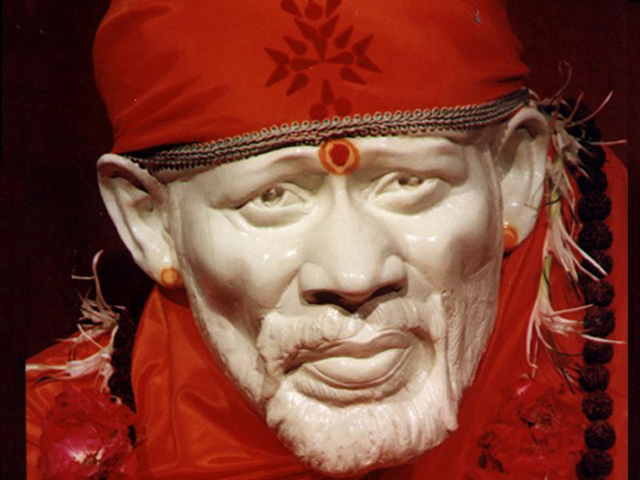
Sai Satcharitra - Ch 3


In the start of the 3rd Chapter Sai Baba tells us why we should read His Leelas. He wants his devotees to learn from his life. Sai Baba was the epitome of all that was good. In his day to day actions we see how we should be leading our lives. Hence it is not enough just to read Sai SatCharitra, but also to practice it's learnings in our life.


As described in the previous chapter, Sai Baba gave His complete assent to the writing of the Sat-Charita and said, "I fully agree with you regarding the writing of Sat Charita. You do your duty, don’t be afraid, steady your mind and have faith in My words. If My Leelas are written, the Avidya (nescience) will vanish and if they are attentively and devoutly listened to, the consciousness of the worldly existence will abate, and strong waves of devotion and love will rise up. If one dives deep into My Leelas, he will get precious jewels of knowledge."

Hearing this, author was pleased, and he at once became fearless and confident, and thought that the work was bound to be a success. Then turning to Shama (Madhavrao Deshpande) Sai Baba said.

"If a man utters My name with love, I shall fulfill all his wishes, increase his devotion. And if he sings earnestly of My life and My deeds, I shall protect him from front, back and from all sides. Those devotees, who are attached to Me, heart and soul, will naturally feel happiness, when they hear these stories. Believe Me that if anybody sings My Leelas, I will give him infinite joy and everlasting contentment. It is My special characteristic to free any person, who surrenders completely to Me, and who worships Me faithfully, and who remembers Me, and meditates on Me constantly. How can they be conscious of worldly objects and sensations, who utter My name, who worship Me, who think of My stories and My life and who thus always remember Me? I shall rescue My devotees from the jaws of Death. If My stories are listened to, all diseases will be got rid of. So, hear My stories with respect; and think and meditate on them, assimilate them. This is the way to happiness and contentment. The pride and egoism of My devotees will vanish, the mind of the hearers will be set at rest; and if it has wholehearted and complete faith, it will be one with Supreme Consciousness. The simple remembrance of My name as ‘Sai, Sai’ will do away with sins of speech and hearing".

Sunday, February 1, 2009

Spanish Verb Conjugation

Again think of Spanish verb conjugation in terms of Hindi Conjugation.Today we will see an overview of the different conjugations.

Infinite Form

To talk
In Hindi we would say बोलना
In Spanish we say hablar.Infinitives in Spanish always end in -ar, -er, or -ir.

Present-tense indicative verbs

I talk, you talk, he talks, she talks, we talk, they talk
In Hindi we would say में बोलता हूँ, तुम बोलते है, वो बोलता है, वो बोलती है, हम बोलतें हैं, वे बोलतें हैं
In Spanish we would say yo hablo, tú hablas, él habla, ella habla, nosotros hablamos, ellos hablan

Future-tense indicative

I will talk, you will talk, he will talk, we will talk, they will talk
In Hindi we would say में बोलूँगा, तुम बोलोगे , वो बोलेगा, वो बोलेगी, हम बोलेंगे, वे बोलेंगे
In Spanish we would say hablaré, hablarás, él hablará, ella hablará, hablaremos, hablarán.

Preterite (a type of past tense)

I talked, you talked, he talked, we talked, they talked.
In Hindi we would say मेंने बोला, तुमने बोला, वो बोला, वो बोली , हम बोले, वे बोले
In Spanish we would say hablé, hablaste, habló, hablamos, hablaron

Present perfect (another type of past tense)

I have talked, you have talked, he has talked, we have talked, they have talked
In Hindi we would say में बोल चुका, तुम बोल चुके, वो बोल चुका, वो बोल चुकी, हम बोल चुकें , वे बोल चुकें
In Spanish we say he hablado, tu has hablado, él ha hablado, ella ha hablado, hemos hablado, han hablado

The gerund and progressive tenses

I am talking, you are talking, she is talking, we are talking, they are talking.
In Hindi we would say में बोल रहा हूँ, तुम बोल रहे हो, वह बोल रहा है, वह बोल रही है, हम बोल रहे है, वे बोल रहे हैं
In Spanish we would say estoy hablando, estás hablando, él está hablando, ella está hablando, estamos hablando, están hablando.

The verb forms are much more extensive in Spanish than they are in English. Also complicating things some is that the most common verbs are also irregular.We will look into each form in detail in the comming weeks

Friday, January 30, 2009

The U.S. presidential race has given us this iconic poster of Obama.This poster is everywhere and become very popular.
So this foto friday let us look at other iconic and a few not so political posters.

Here is one of Nelson Mandela. His power shows through the poster. Very inspiring.

It is also very similar to this poster of Hitler. The eagle in the background is supposed to represent progress and the fist a call to arms.

This poster of Che Guevara has to be the most iconic political poster. Che is one of my inspirations. The original photograph from which this poster is inspired is even more powerful. A personal fave. Sadly this image has now been commercialized to such a large extent that its significance is lost.

Here you can see how Chairman Mao is depicted as almost a Godly figure, with the sun behind him forming a halo and the people bowing before him.


And now for some not so iconic posters.

If Chairman Mao can be depicted as God, then why cant Sonia Gandhi??This poster simply cracks me up.Its more like a case of " Photoshop Gone Wild"..lolThese two election poster of the two main political parties of India are simply uninspiring. Its so boring and not creative. Both fail to inspire anything in me.

The fathers of our nation fared better when it came to inspiring confidence. Both these posters are iconic.They portray our leaders very well.


Thursday, January 29, 2009

Sai Satcharitra - Ch 2

Aum Raajaadhiraaja Yogiraaja ParaBrahma Sainaath Maharaaj
Shri Satchitaanand Sadguru Sainaath Maharaaj ki Jai!


Hemadpant thought that he was not a fit person to undertake the work of writing Baba's Biography. He said, "I do not know the life of my intimate friend nor do I know my own mind, then how can I write about the life of a saint or describe the nature of His Incarnations, which even the Vedas were unable to do? One must be a saint himself, before he can know other saints. Then how can I describe Baba's glory? To write about the life of a saint is the most difficult thing. One may as well measure the depth of the water of the seven seas or enclose the sky with cloth-trappings. I knew, that this was the most venturous undertaking, which might expose me to ridicule. I, therefore, invoked Sai Baba’s grace.

The premier poet-saint of Maharashtra, Shri Jnaneshwar Maharaj, has stated that the Lord loves those who write the lives of saints; and the saints also have a peculiar method of their own of getting the service, which the devotees long for, successfully accomplished. The saints inspire the work; the devotee becomes only an indirect cause or instrument to achieve the end.

The life of Sai Baba is as wide and deep as the infinite ocean; and all can dive deep into the same and take out precious gems (of knowledge and Bhakti), and distribute them to the aspiring public. The stories, parables, and teachings of Sai Baba are very wonderful. They will give peace and happiness to the people, who are afflicted with sorrows and heavily loaded with miseries of this worldly existence, and also bestow knowledge and wisdom, both in the worldly and in spiritual domains. If these teachings of Sai Baba, which are as interesting and instructive as the Vedic lore, are listened to and meditated upon, the devotees will get, what they long for, viz., union with Brahman, mastery in eight-fold Yoga, Bliss of meditation etc. So I thought, that I should call these stories together that would be my best Upasana. This collection would be most delightful to those simple souls, whose eyes were not blessed with Sai Baba’s darshana. So, I set about collecting Sai Baba’s teachings and expressions - the outcome of His boundless and natural self-realization. It was Sai Baba, who inspired me in this matter; in fact, I surrendered my ego at His feet, and thought that my path was clear; and that He would make me quite happy here, and in the next world.


I could not myself ask Sai Baba to give me permission for this work; so I requested Mr. Madhavrao Deshpande alias Shama, Baba’s most intimate devotee, to speak to Him for me. He pleaded for my cause and said to Sai Baba, "This Annasaheb wishes to write Your biography, don’t say that You are a poor begging Fakir, and there is no necessity to write it, but if You agree and help him, he will write or rather, Your feet (grace) will accomplish the work. Without Your consent and blessing, nothing can be done successfully." When Sai Baba heard this request, He was moved and blessed me by giving me His Udi (sacred ashes) and placing His boon-bestowing hand on my head said :- "Let him make a collection of stories and experiences, keep notes and memos; I will help him. He is only an outward instrument. I should write Myself My autobiography and satisfy the wishes of My devotees. He should get rid of his ego, place (or surrender) it at My feet. He who acts like this in life, him I help the most. What of My life-stories? I serve him in his house in all possible ways. When his ego is completely annihilated and there is left no trace of it, I Myself shall enter into him and shall Myself write My own life. Hearing my stories and teachings will create faith in devotees’ hearts and they will easily get self - realization and Bliss; let there be no insistence on establishing one’s own view, no attempt to refute other’s opinions, no discussions of pros and cons of any subject."

Monday, January 26, 2009

You

The best way to think of the pronoun 'you' is to equate it with its counterpart in Hindi

तू -
आप -
usted

But in Spanish there are two more forms of you which are used for the plural form.

तुम लोग - vosotros
आप लोग -
ustedes

Thus it is evident that is used in informal setting while usted is more formal.

Friday, January 23, 2009

Works Of Antoni Gaudi

Last Saturday I had written about La Sagrada Familia and a bit about Gaudi. While La Sagrada Familia is the crown jewel amongst his creations, his other buildings are remarkably beautiful as well. Here is a look at few of them.


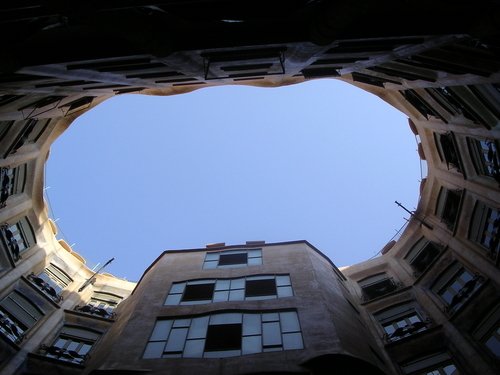
Casa Milà Barcelona, or La Pedrera


Casa Milà Barcelona is an apartment building with a fanciful aura. Wavy walls made of rough-chipped stone suggest fossilized ocean waves. Doors and windows look like they are dug out of sand. A comical array of chimney stacks dances across the roof.

Front Facade

Atrium


Colegio de las Teresianas, or Colegio Teresiano

Antoni Gaudí's Colegio Teresiano is a school for the Teresian order of nuns.Colegio Teresiano was one of Antoni Gaudí's first commissions and stands in sharp contrast to much of Gaudi's other work. The exterior of the building is relatively simple. Colegio de las Teresianas does not have the bold colors or playful mosaics found in other buildings by Gaudi. Gaudi was clearly inspired by Gothic architecture, but instead of using pointed Gothic arches, Gaudi gave the arches a unique parabola shape.


Casa Josep Batlló

Casa Batlló by Antoni Gaudí is decorated with colored glass fragments, ceramic circles, and mask-shaped balconies.The stone façade is decorated with colored glass fragments, ceramic circles, and mask-shaped balconies. The undulating, scaled roof suggests a dragon's back.


Thursday, January 22, 2009

Sai Satcharitra - Ch 1

Starting from this week, I will be posting stories from Sai Satcharitra every Thursday.I hope that this will give readers of this blog something to think upon.I have made corrected some grammatical errors in an effort to make it more readable and also added my own thoughts.


Shri Satchitaanand Sadguru Sainaath Maharaaj ki Jai


This is the first story in Sai Satcharitra. Hemadpant writes, "It was sometime after 1910 A.D. that I went, one fine morning, to the Masjid in Shirdi for getting a darshan of Sai Baba. I was wonder-struck to see the following phenomenon. After washing His mouth and face, Sai Baba began to make preparations for grinding wheat. He spread a sack on the floor; and thereon set a hand-mill. He took some quantity of wheat in a winnowing fan, and then drawing up the sleeves of His Kafni (robe); and taking hold of the peg of the hand-mill, started grinding the wheat by putting a few handfuls of wheat in the upper opening of the mill and rotating it. I thought ‘what business does Baba have grinding wheat, when He possessed nothing and stored nothing, as He lived on alms!’ Some people who had come there thought likewise, but none had the courage to ask Baba what He was doing. Immediately, the news of Baba grinding wheat spread throught the village, and at once men and women ran to the Masjid and flocked there to see Baba's act. Four bold women, from the crowd, forced their way up and pushing Baba aside, forcibly took the peg into their hands, and singing Baba's Leelas, started grinding. At first Baba was enraged, but on seeing the women's love and devotion, He was pleased and began to smile. While they were grinding, they began to think that as Baba had no house, nor property, nor children, and none to look after, and as He lived on alms, He did not require any wheat-flour for making bread or roti.They wondered what He will do with this big quantity of flour? they thought that perhaps as Baba is very kind, He will distribute the flour amongst us. Thinking in this way, they finished the grinding and after putting the hand-mill aside, divided the flour into four portions and began to remove them one per head. Baba, Who had been and quiet up till then, got wild and started abusing them saying, "Ladies, are you gone mad? Whose father's property are you looting away? Have I borrowed any wheat from you, so that you can safely take the flour? Now please do this. Take the flour and throw it on the village border limits." On hearing this, the women felt abashed and whispering amongst themselves, went away to the outskirts of the village and spread the flour as directed by Baba.

I asked the people of Shirdi - "What was this that Baba did?" They replied that as the Cholera Epidemic was spreading in the village,this was Baba's remedy against the same.It was not wheat that was ground but the Cholera itself was ground to pieces and pushed out of the village. From then on, the Cholera Epidemic subsided and the people of the village were happy. I was much pleased to witness all this; but at the same time my curiosity was also aroused. I began to ask myself - 'What earthly connection was there between wheat flour and Cholera? What was the causal relation between the two? And how to reconcile them? The incident seems to be inexplicable. I should write something on this and sing to my heart's content Baba's sweet Leelas'. Thinking about this Leela, my heart was filled with joy and I was thus inspired to write Baba's Life - The Satcharitra.

And as we know, with Baba's grace and blessing this work was successfully accomplished.

Philosophical Significance of Grinding
Apart from the meaning that the people of Shirdi put on this incident of grinding wheat, there is, we think, a philosophical significance too. Sai Baba lived in Shirdi for about sixty years and during this long period, He did the business of grinding almost every day - not, however, of the wheat alone but also the sins, the mental and physical afflictions and the miseries of His innumerable devotees. The two stones of His mill consisted of Karma and Bhakti, the former being the lower and the latter the upper one. The handle with which Baba worked the mill consisted of Jnana. It was the firm conviction of Baba that Knowledge or Self-realization is not possible, unless there is the prior act of grinding away of all our impulses, desires, sins and of the three gunas, viz. Sattva, Raja and Tama; and the Ahamkara, which is so subtle and therefore so difficult to be got rid of.

This reminds us of a similar story of Kabir who seeing a woman grinding corn said to his Guru, Nipathiranjana, "I am weeping because I feel the agony of being crushed in this wheel of worldly existence like the corn in the hand-mill." Nipathiranjana replied, "Do not be afraid; hold fast to the handle of knowledge of this mill, as I do, and do not wander far away from the same but turn inward to the Center, and you are sure to be saved."

Tuesday, January 20, 2009

Obamania : Inauguration of Obama


Today marked an important day in American Political history.It inaugurated it's first non white president. Yes Barack Obama was finally sworn in as the 44th President of the United States Of America.Being a strong opponent of G.W.Bush, I am happy that the Democrats are now in power.Hopefully the months to come will bring a change in the way the war on terror is handled. There are fears in India that Obama will bring in more protectionist legislatures to boost the fagging U.S. economy. But that I think is expected. He will do what he thinks is good for U.S. first. The question arises whether he thinks of the world after that. This is what was missing from the Bush administration.They didn't give a damn about the rest of the world.

But the Obama administration is already showing signs of thinking of not only the U.S. but about the entire world.Obama's message was clear "America is a friend of each nation and every man, woman and child who seeks a future of peace and dignity".I also appreciate the fact that he mentioned Christians and Muslims, Jews and Hindus, and nonbelievers as well in his speech.

And though I respect Obama, the fact is I still America has a long way to go before laying claim as "leader of the world". In fact I think the time when the world was led by a few countries. Each nation should now walk together as one world.


Sunday, January 18, 2009

Stress in Spanish

One of the things that sets Spanish apart from English is the use of stress and accent marks. Spanish being more of a phonetic language, the accent marks become necessary.

BASIC RULES:

  • If a word ends in a vowel, n or s, the stress is on the penultimate (next to last) syllable. For example, toro, computadora, joven and zapatos all have their accent on the next-to-last syllable. Most words fit this category.
  • Words than end in other letters have the stress on the last syllable. For example, hotel, hablar, madador and virtud all have the accent on the final syllable.
  • If a word isn't pronounced according to the above two rules, an accent is placed over the vowel of the syllable that gets the stress. For example, común, piz, dico, inglés, and oja all have the stress on the indicated syllable.
You should be aware that sometimes accent marks are used only to distinguish two similar words, and they don't affect pronunciation (because the marks are already on a syllable that is being stressed). For example, el and él are both pronounced the same way, even though they have quite different meanings. Similarly, some words, such as que and quien, use accent marks when they appear in questions, but usually not otherwise. Accents that don't affect pronunciation are known as orthographic accent

Saturday, January 17, 2009

Oh My Gaudi!!

One of my favourite architect has to be Antoni Gaudi.His creations(calling them mere buildings would be an insult) are one of the reasons that Barcelona figures on my places to visit list.

One of his most iconic buildings is the La Sagrada Familia in Barcelona.It is an enormous church and it is still unfinished.It is a structure unlike any other and the best among all the great works of Gaudi.

The architectural style of Sagrada Familia has been called "warped Gothic," and it's easy to see why. The rippling contours of the stone façade make it look as though Sagrada Familia is melting in the sun, while the towers are topped with brightly-colored mosaics which look like bowls of fruit. Gaudí believed that color is life, and, knowing that he would not live to see completion of his masterpiece, left colored drawings of his vision for future architects to follow.

Learn more about Antonio Gaudi.

Back to TOP